
Inflation Calculator (2026)
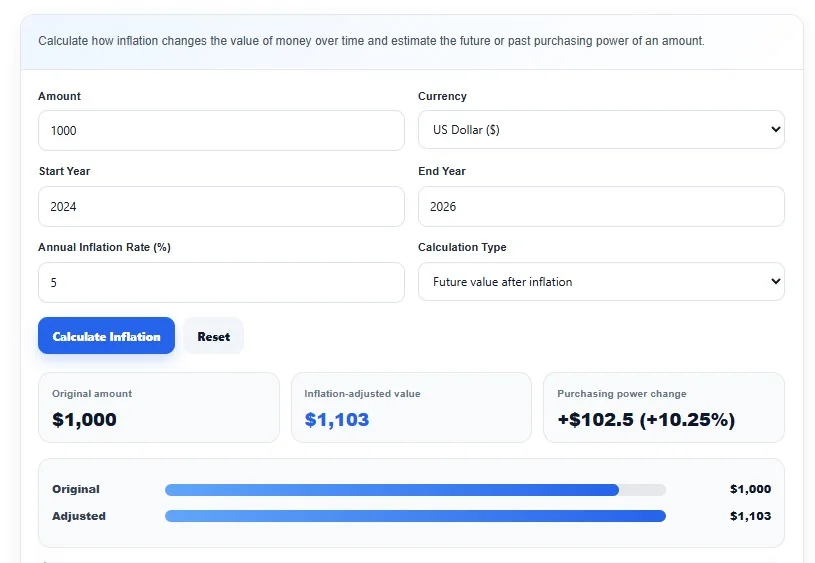
Inflation Calculator helps you estimate how inflation affects the value of money over time. Enter an amount, inflation rate, and time period to calculate future prices and purchasing power instantly. This tool provides a simple way to understand the impact of inflation on savings and everyday expenses.
Inflation Formula
Future Value = Present Value × (1 + Inflation Rate)^Years
Inflation Calculator
Calculate how inflation changes the value of money over time and estimate the future or past purchasing power of an amount.
What Is Inflation?
Inflation is the rate at which the general prices of goods and services increase over time, reducing the purchasing power of money. As inflation rises, the same amount of money buys fewer goods and services than before.
Inflation is one of the most important economic indicators used by governments, central banks, businesses, and investors.
Example Calculation
Suppose:
- Current Amount = $1,000
- Inflation Rate = 5%
- Time Period = 10 Years
Calculation:
Future Value = $1,000 × (1.05)^10
Future Value ≈ $1,629
This means that an item costing $1,000 today would cost approximately $1,629 after 10 years if inflation averages 5% annually.
Inflation Rate Benchmarks
| Annual Inflation Rate | Interpretation |
|---|---|
| Below 2% | Low inflation |
| 2% – 4% | Moderate inflation |
| 4% – 10% | High inflation |
| Above 10% | Very high inflation |
| Above 50% | Hyperinflation |
Frequently Asked Questions (FAQs)
Inflation is the increase in the average price level of goods and services over time.
Inflation can be calculated using the percentage change in prices over a specific period.
Inflation affects purchasing power, savings, wages, investments, and overall economic stability.
Not necessarily. Moderate inflation is generally considered a normal part of a healthy economy.
Inflation can be caused by increased demand, higher production costs, supply shortages, or expansionary monetary policies.