
GDP Growth Rate Calculator
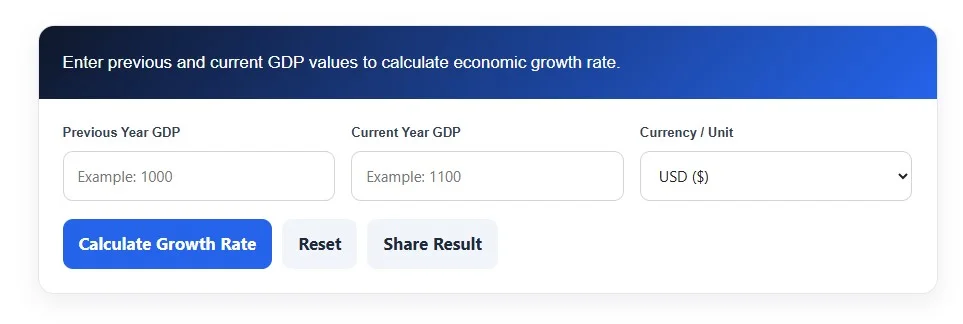
Use the GDP Growth Rate Calculator below to estimate how much an economy has grown or contracted between two periods. Simply enter the previous GDP value and the current GDP value, and the calculator will automatically determine the percentage growth rate.
Enter previous and current GDP values to calculate economic growth rate.
What Is GDP Growth Rate?
GDP growth rate measures the percentage change in a country’s Gross Domestic Product (GDP) over a specific period. It is one of the most important economic indicators used to evaluate economic performance, business activity, and overall economic health.
A positive growth rate indicates economic expansion, while a negative growth rate indicates economic contraction.
How to Calculate GDP Growth Rate
GDP growth rate is calculated by comparing the current GDP with the previous GDP.
Formula
GDP Growth Rate = ((Current GDP − Previous GDP) / Previous GDP) × 100
Example Calculation
Suppose a country’s GDP increased from $1 trillion to $1.1 trillion.
Previous GDP: $1,000,000,000,000
Current GDP: $1,100,000,000,000
Result:
GDP Growth Rate = 10%
This means the economy expanded by 10% during the selected period.
Why GDP Growth Rate Matters
GDP growth rate is widely used by:
- Governments
- Investors
- Businesses
- Economists
- International organizations
It helps assess:
- Economic expansion or contraction
- Business conditions
- Investment opportunities
- Employment trends
- Long-term economic performance
GDP Growth Rate Benchmarks
| Growth Rate | Interpretation |
|---|---|
| Below 0% | Economic contraction |
| 0% – 2% | Slow growth |
| 2% – 4% | Moderate growth |
| 4% – 7% | Strong growth |
| Above 7% | Very rapid growth |
Frequently Asked Questions (FAQs)
A GDP growth rate between 2% and 4% is generally considered healthy for most developed economies.
Yes. Negative GDP growth indicates economic decline or recession.
Not necessarily. GDP growth measures economic output, while living standards also depend on income distribution, inflation, and population growth.
Developing economies generally have more room for expansion, industrialization, and infrastructure development.
Official GDP growth figures are usually reported as real GDP growth, which accounts for inflation.